
Key Information, Social and
Economic Statistics
Geographic Location
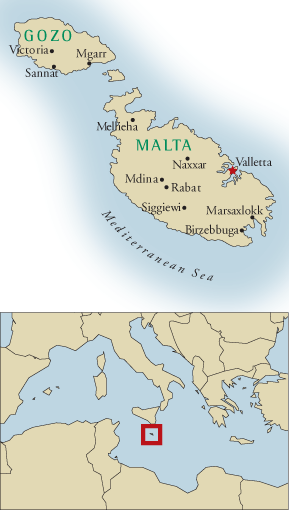
Malta is located in the centre of the Mediterranean, 93 km to the south of Sicily and 290 km to the north of Africa, at the crossroads of Southern Europe, North Africa and the Middle East. Its strategic location makes it an ideal launching pad to enter these markets. Most European and Middle Eastern capitals are between two and four hours flying time away.
Getting to Malta
Flights to and from Malta are available from most of the major European cites. Direct flights to North Africa and the Middle East are also available. The best connected cites are London and Rome with multiple flights daily. Operators to Malta include AirMalta, RyanAir, EasyJet, British Airways, Alitalia, Lufthansa, Emirates, Tuninter amongst many other charter operators. Connection by sea is also possible via Sicily, Salerno, Genoa, Marseille and Tunisia.
The Islands
Malta is a small archipelago of islands consisting of Malta, Gozo, Comino and two uninhabited islands.
Capital City
Area
316 km2
International dialling code
+356
Internet domain
.mt
Currency Unit
Maltese Lira exchange rates (approx.):
- Lm1 = US$2.9
- Lm1 = EUR2.4
Climate
Average temperature (1990-2002):
- Dec – Feb 13.2c
- June – Aug 25.8c
Average annual rainfall (1990 – 2002): 591.3mm
Foreign Relations
Malta enjoys good relations with all countries in the Mediterranean region. Malta pursues a policy of active neutrality. Malta benefits from the Association Agreement with the EU, allowing products manufactured in Malta to enter the EU duty free. Malta also benefits from the GSP scheme of preferences.
European Union
Malta is one of the 10 accession countries that joined the EU in May 2004. Consequently, Malta has many EU convergent regulations already in place, and all new legislation conforms to that of the EU.
Political Stability
Malta is a small, developed, democratic Mediterranean island nation. There are no domestic or foreign policy issues which threaten Malta’s stability or integrity.
Infrastructure
Malta’s infrastructure – air links, transport & logistics electricity grid, telecommunication systems – are of an international standard. The road network is extensive but in need of upgrading.
Standard of Living
Malta enjoys a rich cultural and social life. Malta has a mild climate, with warm dry summers and mild winters and 300 days of sunshine a year. The cost of living is still comparatively low. Property costs are rising, but are still relatively cheap and ample by international standards. Education and health systems are of the highest levels and compare well with those of mainland Europe.
History of the Maltese Archipelago
Malta is a small archipelago of islands located 93 km south of Sicily at the crossroads of Southern Europe, North Africa and the Middle East. Its strategic location makes it an ideal launching pad to enter these markets. Most European and Middle Eastern capitals are between two and four hours flying time away.
At the centre of the Mediterranean, the Maltese Islands enjoy a wealth of heritage. They were once home to ancient civilisations and Europes nobles. Maltas location at the heart of the Mediterranean is the key to its rich history.
At the crossroads of maritime routes, the Islands have been a home, stronghold, trading post and refuge over 7000 years of history. From temple builders, seafaring Phoenicians and the traveller Apostle Paul, to the Knights of St John, Napoleon and British royalty – all have set foot here leaving their imprint for you to discover.
The Islands have several World Heritage sites: the enigmatic, prehistoric temples; Maltas baroque capital Valletta, founded by the Knights; and the walled, medieval capital, Mdina, where descendants of Norman families still live today. The palaces and cathedrals of Valletta and Mdina house some of Europes finest treasures.
Wander around the sister island Gozo and explore gems of a rural life largely untouched by time. And hike across a rugged, terraced landscape fashioned by man over a millennium ago.
The Islands present a kaleidoscope of past and present: a fascinating legacy of European culture and rural Mediterranean traditions.
